

Investing in gold through the Botswana Stock Exchange gives you exposure to the precious metal without keeping gold bars at home. But how does that investment grow, and what happens when you buy units at different prices?
The NewGold ETF offers a way to follow gold’s value through a listed investment. Your return depends on the price you pay, the price you eventually sell for and the costs involved.
This NewGold ETF guide uses hypothetical prices to explain the calculations.
- 1. Understand what the NewGold ETF tracks
- 2. Calculate your NewGold ETF gain
- 3. Average your NewGold ETF purchase costs
- 4. Make regular NewGold ETF contributions
- 5. Match your NewGold ETF holding to a spending date
- Capital gains tax and BURS
- Frequently asked questions
- How do investors make money from the NewGold ETF?
- Does the NewGold ETF pay interest?
- Can the value fall after I buy?
- How should I calculate my average purchase cost?
- Is a regular contribution plan guaranteed to outperform one purchase?
- Who can confirm the capital gains tax treatment?
- What should I check before placing an order?
1. Understand what the NewGold ETF tracks
The NewGold ETF is a commodity exchange-traded fund listed on the Botswana Stock Exchange. Absa describes its structure as gold-backed debentures, with physical bullion held by a custodian. Investors buy and sell the listed securities through the market. Botswana Stock Exchange ETF information, Absa ETF guide.
The bullion debentures do not bear interest. Your potential return comes primarily from changes in their value, with investment and trading costs affecting the result. NewGold prospectus.
For someone investing in Botswana, currency movements also matter. Gold is internationally priced in US dollars, while your local investment is valued in pula. Changes in exchange rates can therefore influence your return alongside changes in gold itself. Absa ETF guide.

2. Calculate your NewGold ETF gain
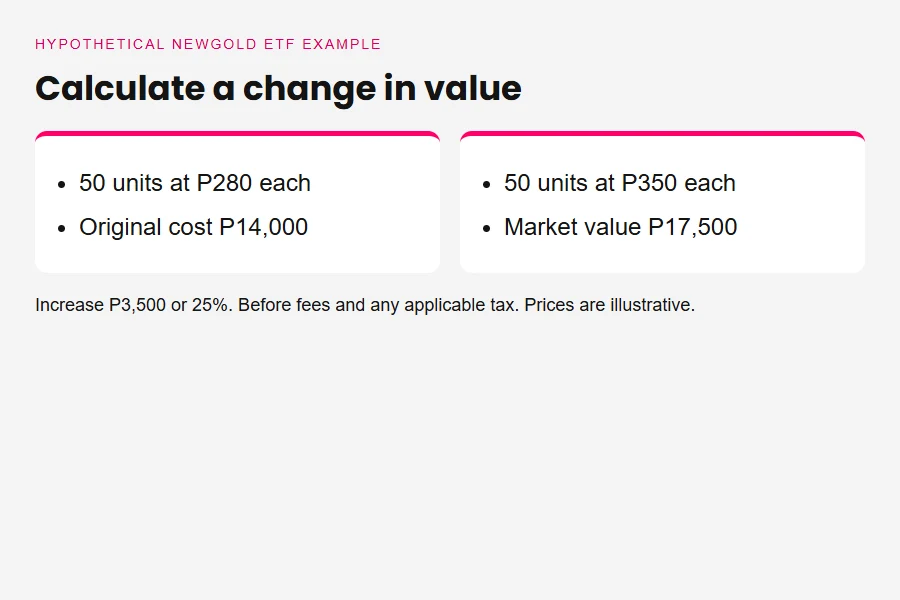
Imagine buying 50 NewGold units at P280 each.
Your purchase costs P14,000 before fees. Later, suppose the price reaches P350 per unit.
| Item | Calculation | Amount |
|---|---|---|
| Original investment | 50 x P280 | P14,000 |
| Later market value | 50 x P350 | P17,500 |
| Increase in value | P17,500 minus P14,000 | P3,500 |
| Percentage increase | P3,500 divided by P14,000 x 100 | 25% |
The holding has gained P3,500 in market value. While you continue to own the units, that amount is an unrealised gain.
If you sell all 50 units at P350, the gross sale proceeds are P17,500. Your result then depends on the actual purchase and sale costs, along with any applicable capital gains tax.
The actual execution price matters. A displayed market price alone cannot establish what you will receive when you sell.
3. Average your NewGold ETF purchase costs
Adding to an investment changes its average purchase cost. To work it out, divide the total amount spent on units by the total number acquired.
Suppose you make these purchases.
| Purchase | Units bought | Price per unit | Purchase amount |
|---|---|---|---|
| First purchase | 40 | P280 | P11,200 |
| Second purchase | 40 | P360 | P14,400 |
| Total | 80 | — | P25,600 |
Your average purchase cost is
P25,600 divided by 80 = P320 per unit
If the market price later reaches P400, the holding would be worth P32,000. Compared with the P25,600 purchase amount, the unrealised increase would be P6,400, or 25%, before costs and any applicable tax.
Because the quantities in this example are equal, averaging the two purchase prices also gives P320.
For different quantities, use the total-cost method. Buying ten units at one price and 100 at another gives much more weight to the larger purchase.
Keep each transaction confirmation so you can check the quantities, prices and charges against your account statement.
4. Make regular NewGold ETF contributions
Investing a fixed cash amount at regular intervals is commonly called dollar-cost averaging. The same approach can be followed with contributions in pula.
Your NewGold ETF contribution buys more units when the price is lower and fewer when it is higher. Investor.gov explanation of dollar-cost averaging.
Consider two hypothetical contributions of P6,000 each.
| Contribution | Amount invested | Unit price | Units bought |
|---|---|---|---|
| First contribution | P6,000 | P300 | 20 |
| Second contribution | P6,000 | P400 | 15 |
| Total | P12,000 | — | 35 |
The average purchase cost is approximately P342.86 per unit, calculated by dividing P12,000 by 35.
Simply averaging P300 and P400 would give P350, which would miss the effect of buying more units at the lower price.
Now suppose the market price is P350. Your 35 units would be worth P12,250, giving an unrealised increase of P250 before costs.
This example shows how the number of units matters. It also shows why a price below your most recent purchase price can still leave the overall holding above its combined cost.
Regular contributions provide a routine, but the routine does not guarantee a profit. A prolonged price decline can leave the investment below its cost. Charges and whole-unit requirements can also affect how much of each contribution gets invested.

5. Match your NewGold ETF holding to a spending date
A NewGold ETF investment becomes easier to assess when it has a purpose. You might be building a future education fund, saving towards a business expense or seeking gold exposure within a broader portfolio.
Write down how much you expect to need and when you will need access to it.
For example, someone saving towards an expense eight years away has a different timetable from someone who must pay a bill in six months. A falling market close to the payment date could force a sale at an unfavourable price.
Absa identifies market, currency and liquidity risks in its commodity ETF material. These investments are not capital protected. Gold’s potential role in diversification does not mean it rises during every recession or period of high inflation. Absa commodity ETF brochure.
Before investing, obtain the latest product documents and ask a stockbroker about executable prices, minimum trade sizes and total charges. The BSE explains that investors buy listed securities through a broker and need a Central Securities Depository account. BSE investor FAQs.
For money tied to a known spending date, compare withdrawal conditions and maturity dates across other savings options. The Botswana fixed deposit calculator lets you explore returns using a bank’s written rate quote.
Capital gains tax and BURS
Capital gains tax is part of the tax treatment to check before spending an investment gain. The Botswana Unified Revenue Service, or BURS, administers Botswana’s income tax rules. Its guidance explains that income tax covers income and gains, with exemptions applying in some circumstances. BURS income tax guidance.
For a NewGold ETF sale, ask BURS or a qualified Botswana tax adviser to confirm whether the gain is taxable, whether an exemption applies and how the transaction should be reported. NewGold is structured as a debenture, so the treatment should be checked for that specific instrument and your circumstances. Absa NewGold product information.
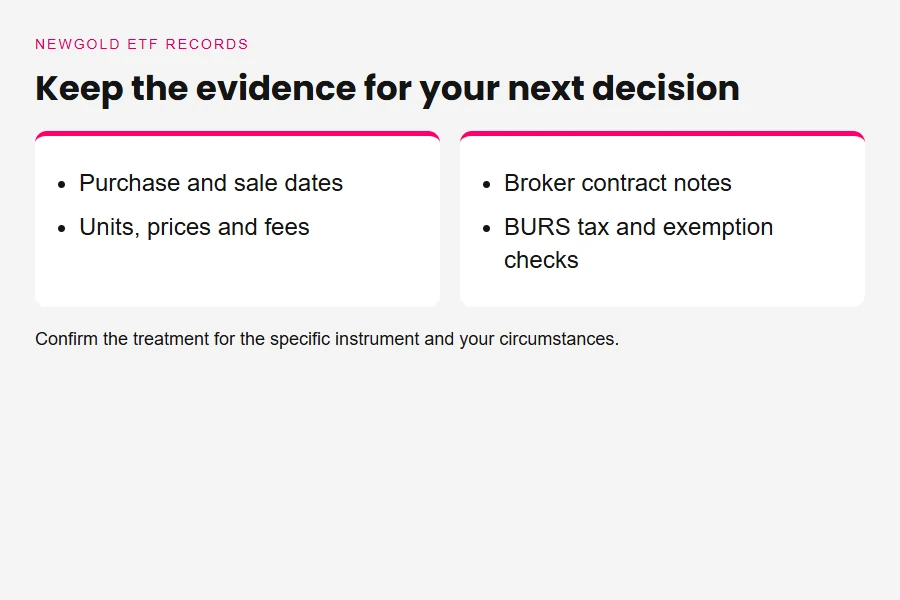
In the earlier example, a P3,500 price gain is the starting calculation before charges and any applicable tax. Keep the purchase and sale contract notes, dates, quantities and fees so the taxable amount, if any, can be established using the applicable rules. Ask BURS which records and return entries are required before treating all the proceeds as available spending money.
Frequently asked questions
How do investors make money from the NewGold ETF?
An investor can realise a capital gain by selling units for more than their purchase cost. Charges and any applicable capital gains tax affect the final result.
Does the NewGold ETF pay interest?
Its gold bullion debentures do not bear interest. The investment provides exposure to changes in gold-linked value.
Can the value fall after I buy?
Yes. Gold prices, exchange rates and market conditions can affect the value of your holding.
How should I calculate my average purchase cost?
Divide the total purchase amount by the total units acquired. Include relevant purchase costs when calculating the amount actually invested.
Is a regular contribution plan guaranteed to outperform one purchase?
Its outcome depends on the prices encountered over time and the costs incurred. Regular contributions can help organise investing, but they do not ensure a better return.
Who can confirm the capital gains tax treatment?
Ask BURS or a qualified Botswana tax adviser to confirm the rules for your NewGold ETF holding, including any exemption and reporting requirements.
What should I check before placing an order?
Read the current product documents, confirm the broker’s charges and understand the order you are placing. Keep the transaction record and review how the holding fits your savings goal.

