
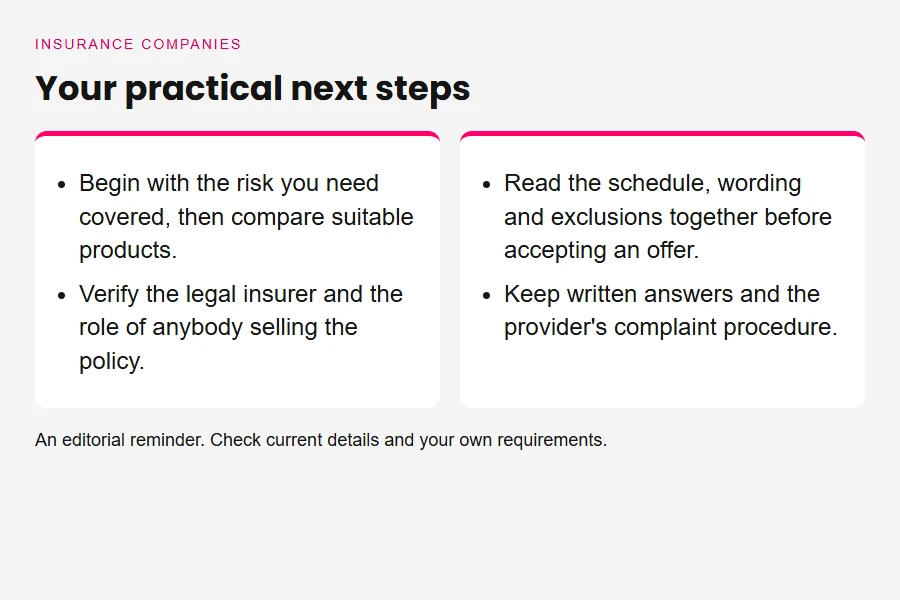
- Begin with the risk you need covered, then compare suitable products.
- Verify the legal insurer and the role of anybody selling the policy.
- Read the schedule, wording and exclusions together before accepting an offer.
- Keep written answers and the provider’s complaint procedure.
Insurance companies should be compared against a specific need, not only a premium or a familiar name. Protecting a vehicle, replacing household contents and arranging life cover are different decisions. A cheap quote for the wrong type of policy cannot solve the problem you intended to address.
This guide offers ten practical checks for approaching insurance companies in Botswana. It uses official regulator and provider information reviewed on 23 November 2026. It does not rank insurers by claims performance or recommend a particular policy for your circumstances.
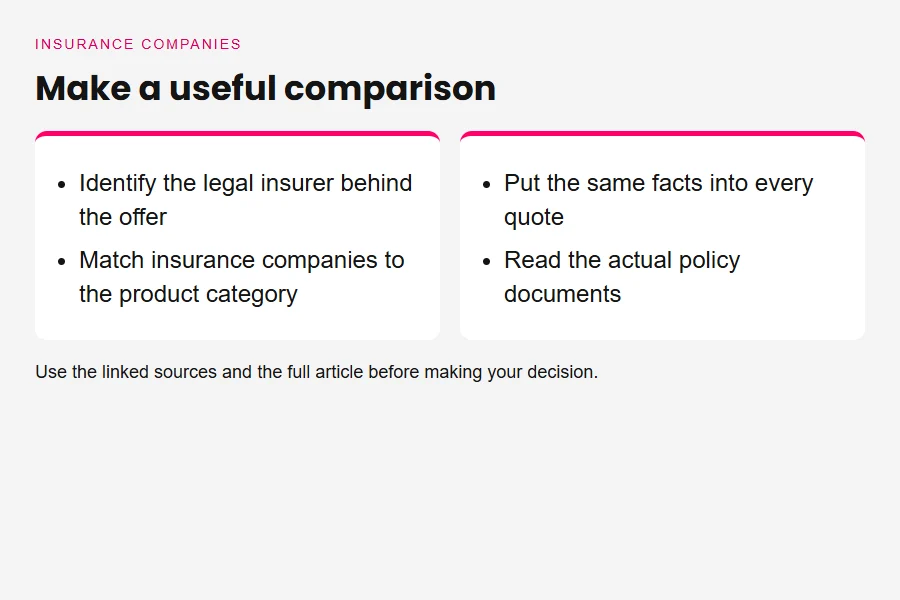
- 1. Identify the legal insurer behind the offer
- 2. Match insurance companies to the product category
- 3. Put the same facts into every quote
- 4. Read the actual policy documents
- 5. Compare insurance companies on limits and exclusions
- 6. Understand what you would pay when claiming
- 7. Check when cover starts and continues
- 8. Ask how changes and duplicate cover are handled
- 9. Learn the claim process before choosing
- 10. Keep a complaint and review route
- A useful comparison sheet for insurance companies
- Frequently asked questions
- Request clear terms rather than a brand ranking
- Sources
1. Identify the legal insurer behind the offer
Find the insurer’s full name and distinguish it from a broker, agent, bank or other distributor. Insurance companies may use different entities for different product categories. Ask whose name will appear on the policy and who carries the insured risk.
Use NBFIRA’s regulated-entity route to check the relevant licence information. If the public list does not provide a clear current match, ask the regulator directly. A familiar trading name should not replace that check.
2. Match insurance companies to the product category
Start with the loss or event that would cause a financial problem. For example, BIC’s personal-insurance range separates motor, buildings, household contents and other covers. Those categories are not interchangeable simply because they share a provider.
Similarly, Hollard’s personal-insurance page lists several general-insurance products, while its life products sit on a separate route. Compare like with like before requesting prices.
3. Put the same facts into every quote
Give each provider a consistent description of what must be insured. Include the relevant people, property, use and value information requested by the application. Ask how to correct an answer if the form does not capture your circumstances accurately.
Insurance companies cannot be fairly compared using materially different assumptions. Keep copies of what you submitted. If advice is given verbally, request a written explanation of the proposed cover and the facts it relies on.
4. Read the actual policy documents
Ask for the proposed schedule, policy wording and applicable endorsements. BIC’s personal-cover document library illustrates how general conditions and separate cover sections can form part of a product’s documents.
Check that the document version applies to your quotation. An old PDF found through search can explain a concept without proving the terms of a new offer. Insurance companies should clarify which documents form your contract before you rely on a benefit.
5. Compare insurance companies on limits and exclusions
Write down the benefits you need, their limits and the circumstances excluded. Ask about any sublimit or condition relevant to the things you most want protected. Do not infer unlimited cover from a product name containing reassuring language.
For a household example, ask whether the item is covered in the home, away from it or only under another section. Request a worked explanation using your situation. This is more useful than counting the number of features in a brochure.

6. Understand what you would pay when claiming
Ask about excesses, deductibles or other amounts you might have to bear, using the terminology in the particular policy. Check whether different events or circumstances change that amount. Insurance companies may structure seemingly similar offers differently.
Compare both the ongoing premium and the financial responsibility if a covered event occurs. A smaller premium is not automatically a better fit when the claim-related amount would be unaffordable for your household.
7. Check when cover starts and continues
Confirm the effective date, payment requirements and any waiting period that applies to the proposed product. Ask what happens after a missed payment, a changed bank account or a requested amendment. Avoid assuming every policy follows the same rule.
For life cover, Hollard’s product information distinguishes whole-life, term and loan-protection options. That difference is a reason to read the specific terms, not evidence that all life policies provide identical benefits.
8. Ask how changes and duplicate cover are handled
Tell the adviser about existing policies relevant to the same need and ask how the proposed product interacts with them. Also ask what changes must be reported, such as a different use or insured location, where applicable.
Insurance companies should explain the effect in writing rather than leaving you to assume that two premiums always mean two full payouts. Our financial-wellness article provides context for reviewing the wider household commitments involved.
9. Learn the claim process before choosing
Ask how to report an event, which documents are needed and what deadlines apply to the exact policy. Keep the genuine claims contact somewhere accessible to the people who may need it. Insurance companies’ general advertising is not a claims-performance comparison.
Ask how progress updates and disagreements are handled. Do not convert one review, testimonial or complaint into a claim that every customer will receive the same outcome. A clear process is useful even when no independent service ranking is available.
10. Keep a complaint and review route
NBFIRA’s complaint procedure starts with the regulated entity’s own process and escalation before the regulator. Retain correspondence and written responses, rather than only the dates of phone calls.
Set a review point when circumstances or renewal terms change. Compare insurance companies again using the same risk description, while checking how cancellation or replacement would affect existing protection. Do not create a gap simply to secure a new headline price.
A useful comparison sheet for insurance companies
| Comparison field | What to record |
|---|---|
| Legal parties | Insurer and intermediary names |
| Intended protection | The event or loss you need covered |
| Contract documents | Schedule, wording and applicable changes |
| Financial terms | Premium, relevant limits and claim-related amounts |
| Conditions | Exclusions, commencement and payment rules |
| Practical support | Claims contact and complaint procedure |
Keep unanswered questions visible. Do not mark offers equal simply because both contain the same product label. Our financial-fitness guide can help place the ongoing cost alongside other commitments.
Frequently asked questions
Which insurer is best in Botswana?
This guide has not measured service or claims outcomes. Compare a suitable product’s terms, affordability and support using your own needs.
Is the lowest premium the best choice?
Not necessarily. Check whether the cover, limits, exclusions and amounts payable when claiming are comparable before deciding.
Is a broker the same as an insurer?
Ask which legal entity provides the cover and what role the intermediary performs. Verify the relevant licensing rather than assuming the roles are identical.
Can I use a South African policy description?
It can suggest questions, but does not establish Botswana eligibility or terms. Ask for the documents applying to the actual local offer.
Where should an unresolved complaint go?
Follow the provider’s procedure and keep written evidence, then consult NBFIRA’s current escalation guidance when the matter remains unresolved.
Request clear terms rather than a brand ranking
Shortlist suitable insurance companies and ask each the same questions. Use our historical insurer overview as background, while verifying current legal entities and policy terms directly before committing.

