


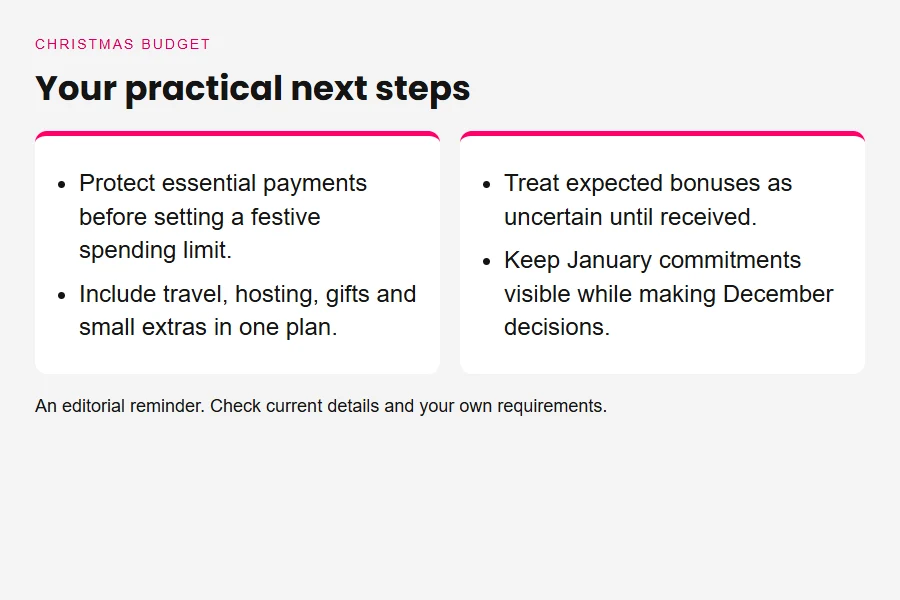
- Protect essential payments before setting a festive spending limit.
- Include travel, hosting, gifts and small extras in one plan.
- Treat expected bonuses as uncertain until received.
- Keep January commitments visible while making December decisions.
A useful Christmas budget starts with what remains after your commitments, not the amount a promotion encourages you to spend. For a Botswana household, the festive season may combine village travel, visitors, food, gifts and family events.
This planning guide uses Botswana financial-education sources and an original illustrative calculation. It does not prescribe a spending percentage or recommend borrowing for celebrations.
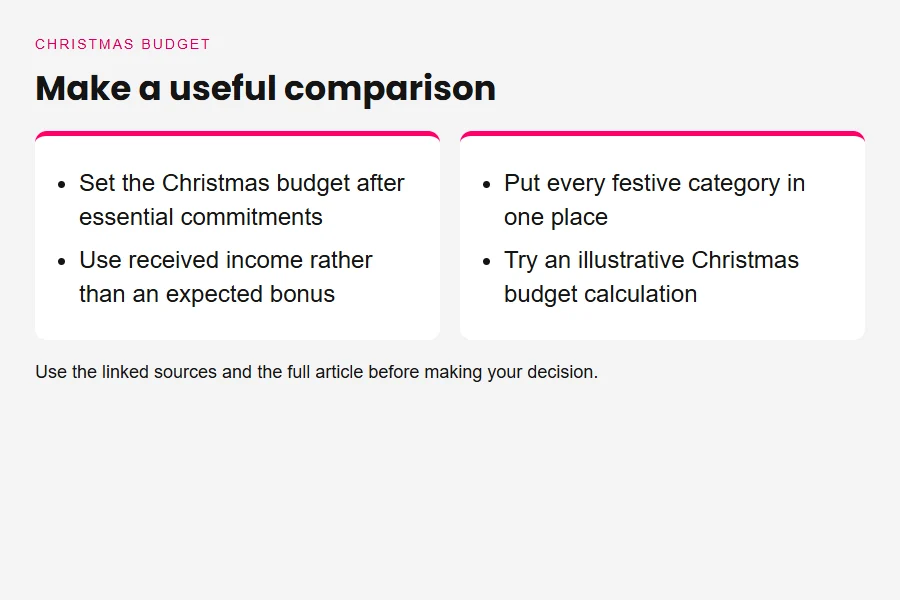
- 1. Set the Christmas budget after essential commitments
- 2. Use received income rather than an expected bonus
- 3. Put every festive category in one place
- 4. Try an illustrative Christmas budget calculation
- 5. Agree on gift expectations before shopping
- 6. Compare travel arrangements using the full trip
- 7. Plan the meal before buying the promotion
- 8. Keep January separate from the festive balance
- 9. Pause before adding debt to the celebration
- 10. Review actual spending while there is time to adjust
- Frequently asked questions
- Make one decision before the next purchase
- Sources
1. Set the Christmas budget after essential commitments
List rent, food, transport, utilities and existing contractual payments before choosing gifts or outings. NBFIRA’s budget guidance distinguishes necessary fixed costs, variable needs and wants.
Write the payments due until the next reliable payday, including any that fall after Christmas. The result may be smaller than your bank balance. That difference matters because money waiting for a debit order is not automatically available for an extra celebration.
2. Use received income rather than an expected bonus
An expected bonus, commission or customer payment can be delayed or differ from your estimate. Keep it outside the available Christmas budget until you receive it. Then decide how much must cover existing commitments before allocating the rest.
FNB Botswana’s budgeting education describes identifying income and expenses and revisiting the plan as circumstances change. If you earn from a side business, separate sales receipts from usable income after its costs. Avoid counting the same money as both business stock funding and household spending.
3. Put every festive category in one place
Create named allocations for gifts, food, travel, outings and any event you are organising. Add wrapping, delivery, parking and other small expenses where relevant. Otherwise several apparently affordable purchases can exceed the overall limit.
Use our shopping-in-Botswana checklist to compare complete purchase costs. Our older rising-costs article is historical context rather than evidence for this year’s prices.

4. Try an illustrative Christmas budget calculation
Imagine a household has P2,400 genuinely available after its essential commitments. The following invented allocation demonstrates arithmetic, not typical Botswana festive costs or a recommended split.
| Illustrative category | Allocation |
|---|---|
| Travel | P700 |
| Additional festive food | P600 |
| Gifts | P500 |
| Outings | P250 |
| Wrapping and delivery | P150 |
| Unallocated contingency | P200 |
| Total available | P2,400 |
The first five allocations use P2,200, leaving P200. If a verified travel quote is P850 rather than P700, the extra P150 must come from somewhere identifiable. Revise another allocation or change the arrangement. Do not leave both the old limit and the higher cost in the plan.
5. Agree on gift expectations before shopping
Discuss whether everyone exchanges gifts, whether there is a per-person limit or whether a shared meal is preferred. Agreeing early can prevent purchases based on assumptions. A group gift needs one organiser and a clear maximum contribution.
Our older birthday-gift ideas may inspire a conversation, but verify current products separately. A Christmas budget works better when the chosen gift suits the recipient and the amount is affordable, rather than when a sale dictates the purchase.


6. Compare travel arrangements using the full trip
Write down both outward and return travel, local transfers and any accommodation you actually need. For driving, use your vehicle’s relevant costs and current fuel information, rather than another household’s estimate. Confirm arrangements before committing to several non-refundable bookings.
NBFIRA’s saving guidance includes planning village visits and travel spending. This is not a reason to abandon important family commitments; it is a reason to discuss dates and costs honestly. Put agreed contributions in the Christmas budget before invitations or bookings create expectations.
7. Plan the meal before buying the promotion
Choose the number of guests and a practical menu, then build the grocery list. Check what is already at home. A bulk offer only helps if the food will be used and can be stored properly.
For example, an invented P100 saving on ingredients is erased by an unnecessary P120 collection trip. Compare the complete basket. Our older grocery-store directory can supply a shortlist, while branch stock and prices need current checking. Do not turn the Christmas budget into a competition over how much food is displayed.
8. Keep January separate from the festive balance
List the commitments that arrive before the next reliable income after the holiday. School-related spending can include transport, uniforms, meals and supplies as well as fees. Ask for actual requirements instead of assuming every family needs the same list.
Botswana Life’s festive-season education newsletter encourages considering January costs while planning celebrations. Move any protected amount out of the festive allocation on paper. A separate category makes it harder to mistake already-committed money for a Christmas budget surplus.
9. Pause before adding debt to the celebration
Compare an instalment’s total obligations with future income, not just the first payment. NBFIRA’s borrowing guidance flags difficulty meeting repayments and borrowing to service existing debt as warning signs. If affordability is uncertain, reduce the planned purchase rather than assume future income will solve it.
Do not sign terms you have not understood. Our older financial-fitness guide offers general background, not an individual debt plan. Contact a lender through its official route if an existing payment is becoming unaffordable.
10. Review actual spending while there is time to adjust
Update the Christmas budget after each substantial purchase. Record the amount paid, the remaining allocation and any changed commitment. Keep receipts and booking confirmations together so that you can explain a discrepancy or return question.
If one category runs over, make the trade-off explicit before buying something else. The Black Friday guide helps assess promotions without assuming a discount is automatically useful. A smaller celebration that fits the available money can still meet the purpose you agreed with family or friends.
Frequently asked questions
How much should a Christmas budget be?
There is no universal figure. Start with usable income, essential commitments and payment dates, then decide what remains for celebrations. Consider the whole household rather than one purchase in isolation. A budget that only works if an uncertain bonus arrives needs a fallback before you make commitments.
Should I spend all of my bonus at Christmas?
That depends on your existing obligations and priorities. Check payments due before the next reliable income and any costs already planned for the new year. Treat the bonus as part of your finances rather than automatically separate fun money. The guide cannot determine the right allocation for your circumstances.
What if relatives expect more than I can afford?
Explain the amount or contribution you can manage early and suggest an arrangement within it. Being specific about a meal, travel contribution or shared gift is often clearer than an open promise. Keep regular support and genuinely unexpected requests separate so the discussion reflects the actual position.
Can a sale help the Christmas budget?
Yes, when it reduces the full cost of something already wanted and affordable. Compare the same specification and include transport, delivery and necessary extras. Buying an unnecessary item because it is discounted still uses money. Keep a dated record of the price if you are comparing offers over time.
What should I do if spending has already exceeded the plan?
Record the true amount and recalculate the remaining commitments. Stop treating the original limit as if it still exists. Identify a realistic adjustment, and contact the relevant provider if an existing payment is at risk. Avoid disguising the shortfall with another optimistic estimate or an unexamined borrowing decision.
Make one decision before the next purchase
Write your total Christmas budget, three largest categories and the January amount you need to protect. Agree on one practical limit with those sharing the cost. Use the plan to choose purchases, rather than rewriting it after every attractive promotion.
Sources
FNB Botswana budgeting education.