



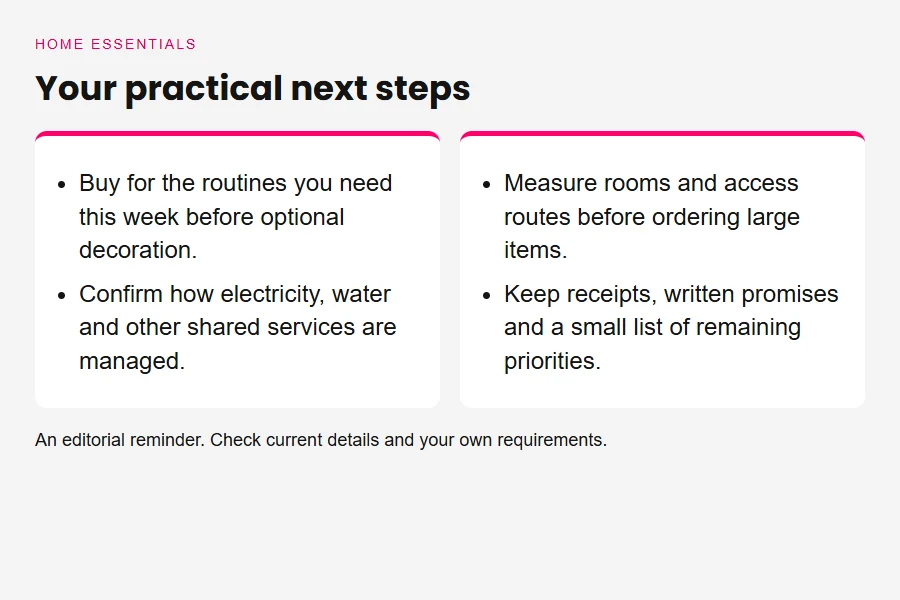
- Buy for the routines you need this week before optional decoration.
- Confirm how electricity, water and other shared services are managed.
- Measure rooms and access routes before ordering large items.
- Keep receipts, written promises and a small list of remaining priorities.
Home essentials are the things that let your household sleep, cook, wash, communicate and manage daily responsibilities. The useful list differs for a rented room, a family house and a first flat in Gaborone.
These 20 checks are a planning framework, not a prescribed shopping basket or a survey of Botswana prices. Check tenancy arrangements and current provider requirements directly.
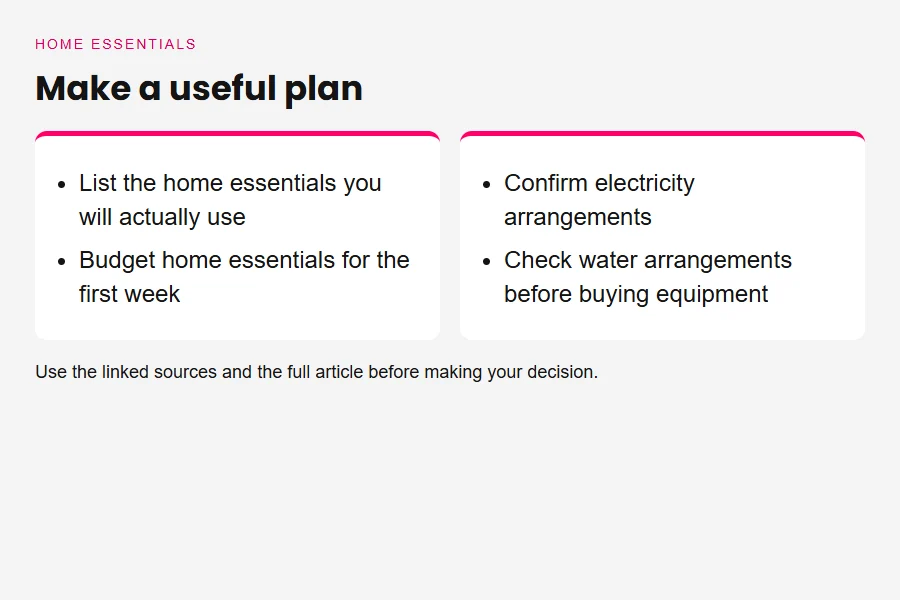
- 1. List the home essentials you will actually use
- 2. Budget home essentials for the first week
- 3. Confirm electricity arrangements
- 4. Check water arrangements before buying equipment
- 5. Record the starting condition
- 6. Measure before choosing bulky home essentials
- 7. Make sleeping arrangements usable first
- 8. Start cooking equipment with actual meals
- 9. Check appliance instructions and installation needs
- 10. Include simple cleaning supplies
- 11. Give laundry a complete route
- 12. Choose lighting by the task
- 13. Notice leaks early
- 14. Make home essentials easy to store
- 15. Plan communication before adding subscriptions
- 16. Keep a practical contact sheet
- 17. Consider the household's changing needs
- 18. Check delivery and returns for home essentials
- 19. Keep a short maintenance list
- 20. Review home essentials after a month
- A simple priority sheet
- Frequently asked questions
- Build a home that works for your routine
- Sources
1. List the home essentials you will actually use
Walk through an ordinary morning and evening. Note the items required for sleeping, washing, preparing food and getting to work or school. Mark what is already available. This identifies missing functions before attractive furniture distracts from the basics.
2. Budget home essentials for the first week
Separate immediate needs from purchases that can wait. In a hypothetical P2,000 allowance, P1,500 of selected purchases leaves P500 for an undecided need, delivery or another priority. The example is arithmetic only, not a statement about adequate household spending.
3. Confirm electricity arrangements
Ask which meter serves the property and who buys or pays for electricity. Record the identifying details carefully. Our older prepaid-electricity guide provides background; confirm the current purchase process through your provider or bank.

4. Check water arrangements before buying equipment
Confirm whether the home has its own account, a shared supply or prepaid arrangements. Ask how problems are reported. Our historical prepaid-water article can suggest questions, but it cannot establish the arrangement at your particular property.
5. Record the starting condition
Photograph existing damage and note which supplied appliances work. Agree with the owner or agent how faults will be reported. Keep that record with the inventory.


6. Measure before choosing bulky home essentials
Measure the intended space, doorway and route into the room. Check whether drawers and doors can open after installation. A cabinet that fits one wall may still obstruct movement. Confirm delivery access before paying for something that may be difficult to return.
7. Make sleeping arrangements usable first
Prioritise a suitable sleeping surface, bedding and a way to manage light and privacy. Check dimensions before buying linen. A complete matching bedroom suite is a different decision from having a usable place to sleep during the first week.
8. Start cooking equipment with actual meals
Choose the pots, utensils and storage needed for the meals you prepare. Count portions and available space. Avoid buying many appliances with overlapping functions before seeing how your kitchen works. Our shopping checklist helps compare the full purchase cost.
9. Check appliance instructions and installation needs
Read the manufacturer’s requirements for placement, connection and maintenance. Ask the seller which parts or installation services are included. Do not assume that a boxed product can be connected safely without additional work. Use a qualified person when the job requires specialist skills.
10. Include simple cleaning supplies
Choose a manageable set for the surfaces in your home and follow product labels. Keep cleaning products identifiable and away from children. Buy the appropriate tool for a job instead of mixing products or assuming that stronger concentrations always give a better result.
11. Give laundry a complete route
Plan where clothes are washed, dried, ironed if needed and stored. Count pegs, hangers and a suitable basket before buying a large machine. Shared accommodation may have restrictions or arrangements that make your preferred appliance unnecessary or impractical.
12. Choose lighting by the task
Check the light needed for cooking, reading and movement rather than brightness alone. BPC’s energy-saving guidance recommends efficient lighting and switching off unnecessary lights. Use fittings suitable for the fixture and follow their instructions.
13. Notice leaks early
Inspect accessible taps and visible pipework and report a persistent drip. Botswana’s Department of Water Affairs conservation advice encourages meter awareness and repairing leaks. Arrange repairs with the responsible person rather than dismantling unfamiliar plumbing yourself.
14. Make home essentials easy to store
Give frequently used items a reachable place. Check whether storage blocks ventilation, doorways or access to equipment. Start with a simple arrangement you can maintain.
15. Plan communication before adding subscriptions
Write down the connection needed for work, study and personal use. Compare coverage, available services and the full recurring commitment. Our older internet-provider directory offers background questions, not a current guarantee of price or performance.
16. Keep a practical contact sheet
Record the owner or agent, utility reference details and people responsible for urgent repairs. Keep an accessible copy without exposing private account credentials.
17. Consider the household’s changing needs
A visitor, new baby or relative moving in can change sleeping, washing and storage requirements. Discuss those changes before buying. Our older newborn essentials article is a starting point for questions, not a substitute for current product-safety or health advice.
18. Check delivery and returns for home essentials
Get the complete price, expected delivery arrangement and process for reporting damage in writing. The Competition and Consumer Authority stresses keeping purchase evidence and seeking clear information. An apparent discount does not answer these practical questions.
19. Keep a short maintenance list
Write the item, observed problem, responsible person and next action. Distinguish an inconvenient cosmetic issue from equipment that should not be used until assessed. Keep maintenance separate from optional upgrades so essential repairs do not disappear into a decoration budget.
20. Review home essentials after a month
Note what you use, what remains unpacked and what still causes difficulty. Buy the next item to solve an observed problem. This review turns a general checklist into your own plan and helps prevent purchasing a second version of something already doing the job.
A simple priority sheet
| Need | What to record | Decision |
|---|---|---|
| Needed immediately | Existing item and missing function | Use, repair or buy |
| Needed later | Expected date and available space | Plan rather than rush |
| Optional | Benefit and full cost | Compare with other priorities |
Frequently asked questions
Must I buy everything before moving in?
Focus on usable daily routines first. What is necessary depends on what the property supplies and what you already own. Keep a remaining-items list after the move. That gives you time to verify dimensions, actual use and delivery arrangements instead of buying an unsuitable complete set.
Are second-hand home essentials always cheaper?
Compare the full cost, condition, transport and any necessary repair. A low price alone cannot establish value or safety. Ask questions and inspect where practical. Avoid assuming that a seller’s photograph proves an appliance works or that an old product carries the same support as a new one.
How should housemates divide purchases?
Discuss ownership, payment and what happens when somebody leaves. Record the agreement in simple language and keep receipts accessible to the people involved. A clear decision before purchasing is more useful than assuming everybody has the same understanding afterwards.
What should a first-home checklist leave out?
Leave out items that have no clear use, will not fit or duplicate something already available. Do not remove essential safety or accessibility needs just to shorten the list. Review optional decoration separately so that a tight budget is directed toward the daily jobs your home must support.
What is the best first step today?
Walk through one morning routine and list the missing functions. Measure one uncertain space and verify one account arrangement. Those small checks turn home essentials from a long shopping wish list into a short set of decisions that you can price and complete in a sensible order.
Build a home that works for your routine
Choose three home essentials to verify this week, then use the Botswana buying checklist before spending. Keep the list practical and update it when real use reveals a better priority.