

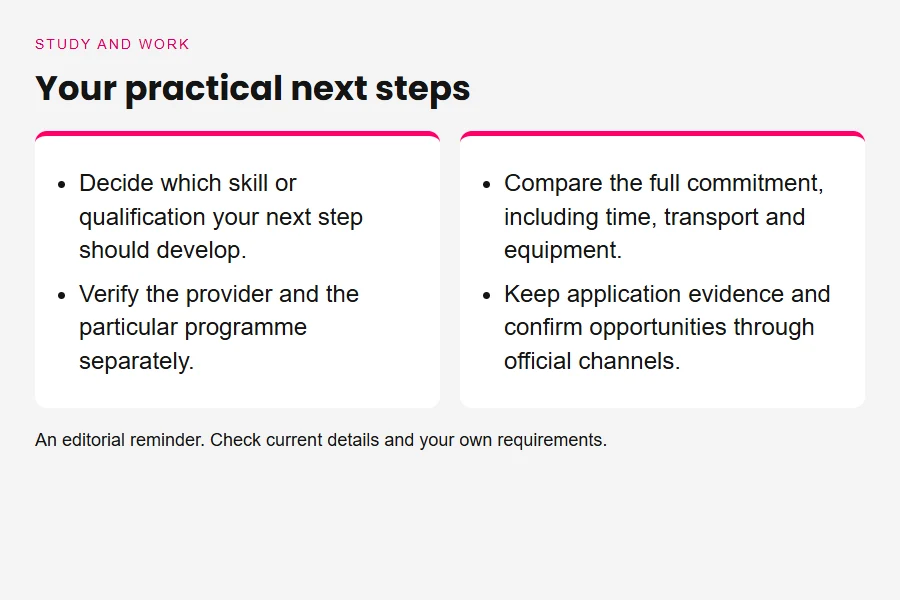
- Decide which skill or qualification your next step should develop.
- Verify the provider and the particular programme separately.
- Compare the full commitment, including time, transport and equipment.
- Keep application evidence and confirm opportunities through official channels.
Study and work decisions become clearer when you compare routes against the same goal. A degree, a vocational course, an internship and a short course do different jobs. The useful question is what you need to learn or demonstrate next, rather than which advert looks most impressive.
This Botswana guide explains ten checks for building a sensible shortlist. It does not guarantee admission, sponsorship, placement or employment. Current intake dates and eligibility belong to the institution or programme concerned, so verify them before applying or paying.
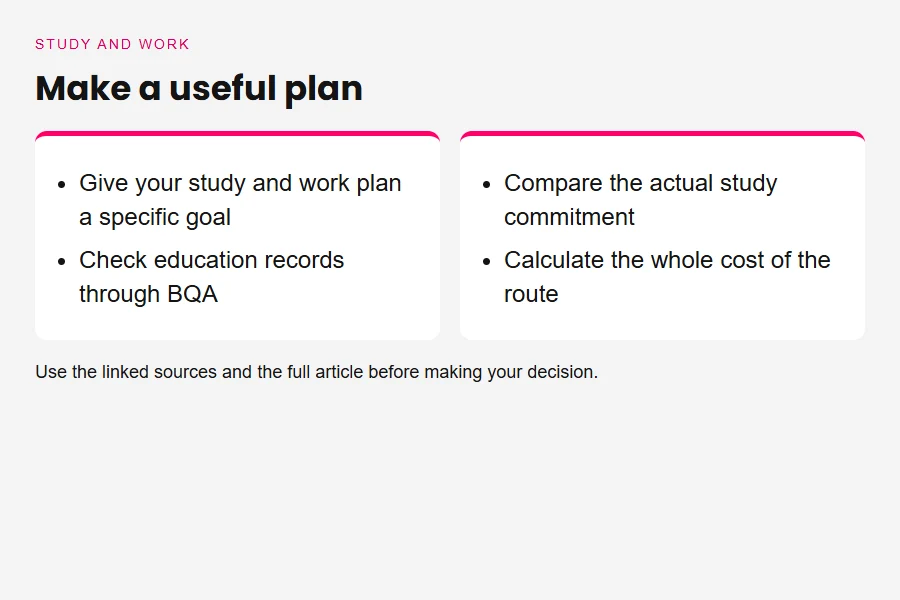
- 1. Give your study and work plan a specific goal
- 2. Check education records through BQA
- 3. Compare the actual study commitment
- 4. Calculate the whole cost of the route
- 5. Keep admissions and funding decisions separate
- 6. Build an honest evidence folder
- 7. Investigate legitimate experience routes
- 8. Tailor each application to the actual opportunity
- 9. Verify requests for money and private information
- 10. Review the study and work plan after each result
- A shortlist worth keeping
- Frequently asked questions
- Choose one verified next step
- Sources
1. Give your study and work plan a specific goal
Describe a task you want to become capable of doing. That might be preparing accounts, repairing equipment, teaching a particular age group or managing a small business. Then identify what employers or clients actually require for that task.
Write down your present qualifications, available time and practical constraints. A study and work plan should connect the next activity to evidence of a useful skill, not simply add another certificate to a folder.
2. Check education records through BQA
Use the Botswana Qualifications Authority educational records to investigate providers, qualifications and accredited learning programmes. These are distinct records. Finding an institution’s name does not mean you have verified every programme it advertises.
Record the exact provider, programme title, qualification and any relevant validity information. If the record is unclear, ask BQA and the institution before paying. Our older Botswana university overview is background reading, not a substitute for current regulatory and admissions information.
3. Compare the actual study commitment
Ask how teaching, assessments and practical work are delivered. Check attendance requirements and where examinations or placements occur.
For one official starting point, Botswana Open University’s academic-services information describes open-schooling and tertiary provision in its Kang region. Confirm the programme, location and intake relevant to you directly. Study and work can fit together only if the timetable and workload fit the hours you really have.
4. Calculate the whole cost of the route
Include verified fees, transport, accommodation if necessary, connectivity, books, equipment and the income you may forgo. Separate confirmed quotations from estimates. Ask which charges are compulsory and when they become due.
Here is an original hypothetical comparison, not current tuition pricing. If one option costs P2,000 in fees and P600 in travel, its visible total is P2,600. Another at P2,300 with P100 travel totals P2,400. The second is P200 lower on those assumptions, even though its fee is higher.
5. Keep admissions and funding decisions separate
An offer of admission does not establish that funding has been approved. Read each application’s conditions, required documents and deadlines. Keep confirmation from the appropriate organization, rather than relying on a promise passed through an intermediary.
Make your study and work plan viable under the conditions actually confirmed. If funding remains uncertain, ask what happens to registration, deposits and withdrawal before committing. Our historical money-making guide offers ideas to assess, not a guarantee that side income can cover a course.

6. Build an honest evidence folder
Organize qualifications, transcripts, an up-to-date CV and examples of relevant work. Name files clearly and keep a secure backup. Describe your own contribution accurately when an example was produced by a team.
A useful study and work record can include a small project, supervised practical task or portfolio where the field permits it. Do not invent employment, references or achievements. Our earlier guide to applying without experience supplies further background on presenting a starting position honestly.
7. Investigate legitimate experience routes
Read the official government reporting on the National Internship Programme if it may fit your circumstances. This July 2025 report describes programme reforms, rather than confirming a current intake or your eligibility. Verify current requirements through the responsible department.
Do not confuse registration with a secured placement. For other internships or attachments, confirm the employer, supervision, duties, duration and any allowance in writing. A study and work opportunity should explain what you will do and learn rather than sell an undefined promise of access.
8. Tailor each application to the actual opportunity
Read the requirements before reusing an old CV or letter. Show the relevant qualification, skill or example requested. Use the organization’s specified submission method and check that attachments open correctly.
Keep an application tracker with the date, organization, role or programme, source and response. This makes follow-up more accurate and prevents applying twice through different intermediaries. Study and work applications benefit from clear evidence; sending a larger number of unrelated documents does not automatically improve them.
9. Verify requests for money and private information
Open the institution or employer’s official website independently when checking an unexpected message. Use contact details obtained there to confirm payment instructions or document requests. A familiar logo in a message is not proof of an official relationship.
Only send information needed for the legitimate application, through the approved route. Avoid posting identity documents in public groups. Our card-security background guide gives related cautions, while your bank’s current instructions should govern a suspected compromise.
10. Review the study and work plan after each result
Record what an acceptance, rejection or information request changes. You may need another prerequisite, a clearer work example or a different delivery mode. Ask for useful clarification where the organization provides it.
Set a realistic next action rather than assuming that one result decides your entire future. Our work-life-balance article offers background for discussing competing commitments.
A shortlist worth keeping
| Question | Evidence to record |
|---|---|
| Does the route support my goal? | Relevant skill or recognized qualification |
| Can I complete it? | Timetable, location and prerequisites |
| Can I afford the commitment? | Confirmed costs and funding conditions |
| Is the opportunity legitimate? | Official records and verified contact route |
Frequently asked questions
Can I study while employed?
Check the specific timetable, attendance and assessment requirements with the provider. Discuss any workplace commitments before assuming flexibility. A part-time or distance option can still involve fixed activities. Compare the actual weekly workload with the hours available to you, including travel, family responsibilities and time for independent study.
Does provider registration prove my chosen course is accredited?
Verify the particular programme and qualification as well as the provider. BQA maintains different educational records, and a matching institution name alone is not a complete check. Keep the exact programme title and ask for clarification when an advert and the official record do not clearly match.
Should I pay somebody who promises a placement?
Verify the opportunity independently before sending money. Ask the named employer or programme office about the person and the alleged payment requirement. A claim of guaranteed access is not evidence of a legitimate arrangement. Keep messages and use the organization’s own published route to confirm what is required.
What if I do not meet the entry requirements?
Ask the institution which legitimate alternatives apply, such as a different level or a required prerequisite. Do not alter results or use false documents. Compare the time and cost of closing the gap with other suitable routes. Keep any advice in writing so that your next application uses the correct information.
What should I do before choosing between two offers?
Compare recognition, content, delivery, full cost and the conditions attached to each. Check unresolved funding or placement assumptions separately. Speak to the official contacts about what remains unclear. The more useful option is the one that fits your goal and real circumstances, rather than the more impressive advertising headline.
Choose one verified next step
Give your study and work plan a clear goal, two suitable routes and one action this week. Use the qualification-checking starting point, then prepare the evidence the actual opportunity requests.
Sources
Government reporting on internship programme reforms.
Botswana Open University academic services.

