
- Start with money you can actually use, rather than your gross salary.
- Record payment dates as well as monthly totals.
- Include school costs, family commitments and irregular bills explicitly.
- Review the plan against real spending before changing your targets.
A household budget works when it shows what your money must do before the next payday. For a Botswana household, that might mean rent in town, food, transport, electricity and support for relatives elsewhere. Start with your own records, rather than somebody else’s percentages.
This guide combines current Botswana financial-education sources with an original worked planning example. The example is not a claim about typical salaries or living costs, and the guide does not recommend a particular account or loan.
- 1. Start your household budget with usable income
- 2. Add payment dates to your household budget
- 3. Group household budget costs by purpose
- 4. Include family commitments honestly
- 5. Check a complete worked household budget
- 6. Include school costs in your household budget
- 7. Match saving goals to the actual gap
- 8. Recognise when debt needs attention
- 9. Test one change against real spending
- 10. Review your household budget regularly
- Frequently asked questions
- Make your next spending decision clearer
- Sources
1. Start your household budget with usable income
Write the amount you receive after payroll deductions, then check when it arrives. Avoid treating a gross salary as spendable cash. Put uncertain overtime, commissions and occasional side-business receipts in a separate column until you receive them.
FNB Botswana’s budgeting guide includes regular earnings and service income among possible sources. For your household budget, distinguish money that reliably covers commitments from money that may not arrive. If you run a small business, separate customer receipts from the amount available after its costs.
2. Add payment dates to your household budget
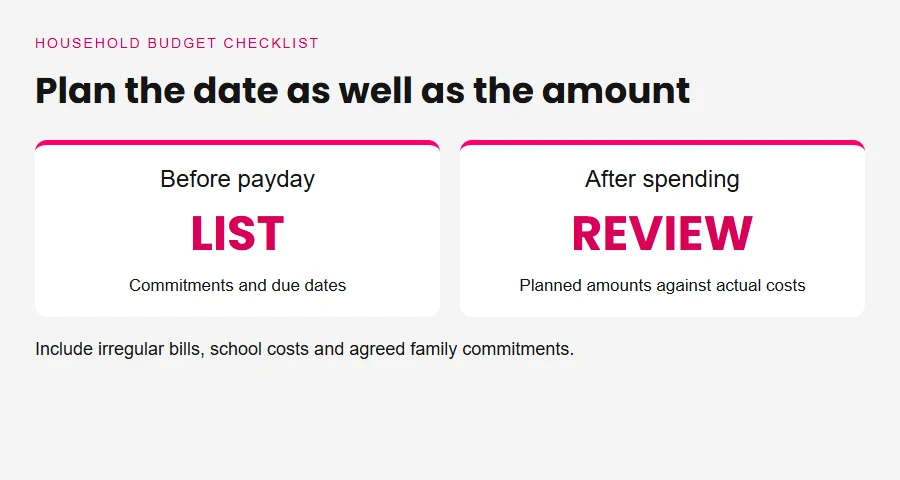
A monthly total can look manageable while the first week is impossible. Draw a simple calendar with payday, rent, debit orders, transport needs and other fixed commitments. Write the expected amount beside each date.
Then calculate the balance after each payment. If income arrives on the 25th and rent leaves on the 1st, keep the rent allocation intact across that week. This shows when cash is committed and which arrangements need attention.
3. Group household budget costs by purpose
NBFIRA’s budget guidance distinguishes fixed needs, variable needs and wants. Use that distinction without assuming every household has the same priorities. Transport to work can be essential even when the amount varies.
Your household budget should also show occasional costs separately. A celebration, annual renewal or repair is easy to forget when it has no monthly debit order. List foreseeable expenses and dates, using actual quotations.
4. Include family commitments honestly
If you regularly contribute to another household, write that amount down. Discuss what is affordable and which requests need a separate decision. Do not hide a recurring commitment in an undefined miscellaneous category.
For example, a hypothetical P300 monthly contribution uses P3,600 over twelve months. That arithmetic helps make the commitment visible; it does not establish what anybody should contribute. When income changes, revisit the arrangement respectfully instead of relying on an amount that leaves essential bills uncovered. Shared expectations make the household budget easier to use.
5. Check a complete worked household budget
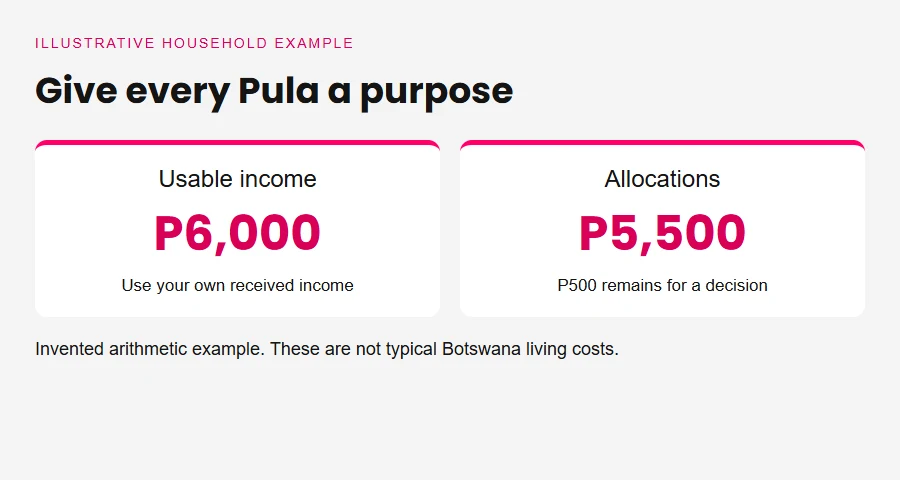
The following invented example demonstrates a calculation. These figures are not Botswana price averages, a recommended allocation or a promise that P6,000 meets a particular family’s needs.
| Example item | Monthly allocation |
|---|---|
| Usable income | P6,000 |
| Housing | P1,800 |
| Food | P1,200 |
| Transport | P700 |
| Utilities and communication | P500 |
| Contractual debt payments | P600 |
| Family contribution | P300 |
| Irregular-cost reserve | P400 |
| Unallocated balance | P500 |
The listed allocations total P5,500. Subtracting them from P6,000 leaves P500. That balance still needs a decision; it is not automatically spending money. Replace every line with your figures, add omitted needs and check that you have not counted the same expense twice.

6. Include school costs in your household budget
NBFIRA’s school-fees planning guidance includes uniforms, meals, transport and study extras alongside tuition. Ask the school for current written information rather than carrying last year’s figure forward.
If an invented P1,200 expense is due in three months, setting aside P400 each month would cover that amount. It only works if the P400 is genuinely available and the expense stays unchanged. Put both assumptions into your household budget and check them before the deadline.
7. Match saving goals to the actual gap
NBFIRA’s saving guidance encourages setting money aside and preparing for unexpected costs. Start by naming what the money is for and when you may need it. An annual school purchase and an unpredictable emergency are different planning jobs.
For account questions, our older savings-account guide supplies background. Verify current fees, access restrictions and terms directly. Do not select an account because an old article calls it best, or promise yourself savings that the current household budget cannot support.
8. Recognise when debt needs attention
NBFIRA identifies difficulty meeting repayments and borrowing to repay existing debt as warning signs in its reckless-borrowing guidance. List balances, instalments, interest terms and overdue amounts so that you understand the position.
If payments are unaffordable, contact the creditor through its official route to discuss the circumstances. Do not assume that another loan fixes the underlying gap. Our insurance comparison checklist is separate background, not a reason to cancel necessary protection without checking the consequences.
9. Test one change against real spending
Choose a specific change you can measure. For groceries, compare a planned basket including transport, rather than chasing several small discounts. Use our shopping-in-Botswana guide to check the full cost.
Record the result for a week. If a hypothetical P50 saving requires an extra P60 trip, the change costs P10 more overall. A household budget should expose that trade-off. Our older rising-costs article offers historical context, not current price evidence.
10. Review your household budget regularly
Compare planned and actual amounts on a date you can maintain. FNB’s budgeting guidance recommends revisiting the plan when income or expenses change. Keep a short note explaining large differences instead of silently changing the old numbers.
Was the estimate wrong, the payment unexpected or the timing inconvenient? Each answer suggests a different adjustment. Keep the previous version. If the same essential shortfall repeats, treat it as a problem requiring a realistic change or qualified assistance, rather than a failure of willpower.
Frequently asked questions
Do I need a budgeting app?
No particular app is necessary for this method. A notebook or spreadsheet can record income, commitments, dates and actual spending. Choose something you will review. Keep private financial information secure, and do not upload account statements to an unfamiliar service simply because it offers an attractive template.
Should every household use the same percentages?
No single split can establish what is affordable for every family. Housing, dependants, transport and existing obligations differ. Calculate your actual position first. Treat an online percentage rule as a discussion aid rather than proof that your circumstances, commitments or essential costs should fit an identical pattern.
How do I budget with irregular income?
Separate reliable receipts from uncertain ones and list essential payments by date. Update the plan when money arrives. Avoid spending an expected commission twice by allocating it before receipt and again afterwards. If the available income cannot cover commitments, address the gap rather than hiding it with optimistic estimates.
Should family support count as an emergency?
If it is a regular commitment, give it a named allocation. Genuinely unexpected requests can then be considered separately. Discuss limits and timing with those involved. This is a planning distinction, not a judgment about family responsibilities or a recommendation that everybody should contribute the same amount.
What is the first useful task today?
Write your next income date and the payments due before the following one. Check the figures against records you already have. That gives you a practical starting position. Then choose one uncertain amount to verify, rather than trying to perfect an entire year’s plan in one sitting.
Make your next spending decision clearer
Use this household budget as a framework for your own figures. Next, apply the shopping checklist to one planned purchase. Link the buying decision to the amount and payment date already recorded in your plan.
Sources
FNB Botswana budgeting education.
NBFIRA education-cost planning.
NBFIRA borrowing warning signs.

